
Leukapheresis for CAR-T Therapy: How We Do It
Overview and Our Mission
Chimeric antigen receptor (CAR)-T cell therapy is an advanced cellular immunotherapy in which a patient’s own T cells are genetically modified to recognize and attack cancer cells. CAR-T therapy has been incorporated into routine clinical practice worldwide for relapsed or refractory hematologic malignancies, particularly malignant B-cell lymphomas and multiple myeloma. In recent years, its clinical applications have been expanding beyond oncology, with autoimmune diseases emerging as a promising area of investigation. At Keio University Hospital, we support all CAR-T products currently available under the Japanese health insurance system, including products for relapsed or refractory B-cell lymphoma, B-cell acute lymphoblastic leukemia, and multiple myeloma [Table 1].
The Center for Transfusion Medicine & Cell Therapy leads the leukapheresis process for CAR-T cell manufacturing, working closely with a multidisciplinary team that includes treating physicians, clinical engineers, laboratory technologists, nurses, pharmacists, coordinators, and manufacturing partners. Our aim is to contribute to the safe and seamless delivery of CAR-T therapy to each patient as an integral member of the treatment team.
Table 1. CAR-T product approved in Japan. (May, 2026)
| Name of product(Brand name) | Targeted disease | Targeted antigen |
|---|---|---|
| Tisagenlecleucel (Kymriah) |
relapsed/ refractory LBCL relapsed/ refractory B-ALL |
CD19 |
| Axicabtagene ciloleucel (Yescarta) |
relapsed/ refractory LBCL | CD19 |
| Lisocabtagene maraleucel (Breyanzi) |
relapsed/ refractory LBCL relapsed/ refractory FL relapsed/ refractory MCL relapsed/ refractory MZL |
CD19 |
| idecabtagene vicleucel (Abecma) |
relapsed/ refractory MM | BCMA |
"LBCL: Large B-cell lymphoma, B-ALL: B-cell acute lymphoblastic leukemia, FL: Follicular lymohoma,
MCL: Mantle cell lymphoma, MZL: Marginal zone lymphoma, MM: Multiple Myeloma
BCMA: B-cell maturation antigen"
Leukapheresis for CAR-T therapy
Leukapheresis is the first essential step in the treatment pathway because the patient’s leukocytes serve as the starting material for the therapy. During leukapheresis, blood is continuously drawn from the patient through vascular access, processed through an apheresis device, and separated into cellular components. The required cellular fraction, including mononuclear cells and lymphocytes, is collected for manufacturing, while the remaining blood components are returned to the patient.
Although leukapheresis has long been established in peripheral blood stem cell collection (PBSCC), leukapheresis for CAR-T therapy requires a different procedural approach. Unlike stem cell collection performed under mobilization, leukapheresis for CAR-T therapy is performed in a non-mobilized setting. In addition, each patient presents with different clinical conditions, including disease activity, number of prior treatment lines, peripheral blood cell counts, vascular access, and hemodynamic tolerance. Moreover, there is no standardized protocol for leukapheresis, and each CAR-T product has specific collection and handling requirements.
Leukapheresis usually takes several hours, during which the patient’s condition, blood flow, anticoagulation status, and collection progress change. Therefore, multiple procedural parameters must be monitored and adjusted in real time to tailor the procedure to each patient. For these reasons, leukapheresis for CAR-T therapy should not simply be approached as an extension of conventional PBSCC, but should be planned and managed as a dynamically adjusted, patient- and product-specific clinical procedure.
Our Multidisciplinary Approach to Leukapheresis for CAR-T therapy
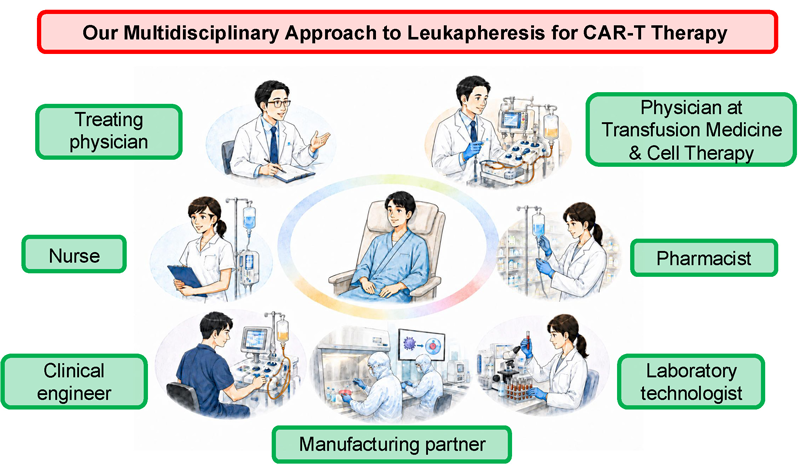
At the Center for Transfusion Medicine & Cell Therapy, leukapheresis is performed by a dedicated multidisciplinary team that includes transfusion physicians, clinical engineers, laboratory technologists, and nurses, in close collaboration with the treating clinical department [Figure1]. Before collection, the team evaluates clinical and procedural factors such as patient condition, blood counts, vascular access, anticoagulation-related considerations, and product-specific collection requirements.
During collection, we continuously assess both patient status and procedural progress in real time and adjust device settings and collection parameters appropriately to balance patient safety, procedural stability, and efficient cell collection. For example, clinical engineers play a key role in maintaining stable operation of the apheresis device and extracorporeal circuit. Laboratory technologists evaluate blood tests and collection-related samples, and share information required for cell manufacturing with the relevant departments and manufacturing partners.
After collection, the team coordinates product-specific handling and shipment of the collected material to the manufacturing facility. Once manufacturing is completed, the Center is responsible for receipt, storage, and management of the CAR-T product, thereby supporting continuity from leukapheresis to infusion. This team-based approach allows us to tailor leukapheresis to each patient and each product, while maintaining close communication across the clinical, technical, laboratory, and manufacturing interfaces.
Our Future and Continuous Improvement
As the clinical applications of CAR-T cell therapy continue to expand, the number of available cellular therapy options is also increasing. This makes it increasingly important to identify the most appropriate treatment for each patient and to establish a robust system that can deliver it safely and reliably.
The Center for Transfusion Medicine & Cell Therapy will continue to support clinical departments by working collaboratively across disciplines and by applying the expertise of each professional involved in the cellular therapy pathway. In addition to daily clinical practice, our center is engaged in research aimed at improving leukapheresis strategies for CAR-T cell therapy and better understanding procedural performance.
Our goal is not only to perform leukapheresis safely, but also to refine how it is planned, monitored, and evaluated. By integrating clinical experience with procedural data, we aim to contribute to safer, more efficient, and more reproducible leukapheresis, and to help deliver advanced cellular therapies to patients without delay.
For further information regarding our CAR-T leukapheresis program, please contact the Center for Transfusion Medicine & Cell Therapy.
Frequently Asked Questions for Healthcare Professionals
-
How much experience does your center have with leukapheresis for CAR-T therapy?
In close collaboration with the Division of Hematology and the Division of Pediatrics at Keio University Hospital, the Center for Transfusion Medicine & Cell Therapy supports all CAR-T products currently available under the Japanese health insurance system. To date, our center has performed approximately 300 leukapheresis procedures for CAR-T therapy.
-
How long does each CAR-T leukapheresis take?
The actual procedure time depends mainly on three factors: the patient’s condition, apheresis-related procedural conditions, and product-specific requirements. These include the type of vascular access, blood flow, anticoagulation management, peripheral blood cell counts, and the planned blood processing volume. In general, leukapheresis for CAR-T therapy takes three to four hours.
-
What type of vascular access should be used?
The choice of vascular access is basically determined according to the patient’s venous condition and safety considerations. At our center, we perform leukapheresis for CAR-T therapy using a temporary central venous catheter (mostly placed in the femoral vein) in all cases, with the aim of ensuring stable blood flow and procedural safety throughout the collection.
-
What procedural parameters are adjusted during leukapheresis in real time?
The team monitors and adjusts procedural parameters such as blood flow, anticoagulation settings, collection interface, and device-related collection settings when appropriate.
-
Do you use product-specific collection workflows?
Yes. Each CAR-T product has specific requirements for collection and handling. At our center, we develop and implement appropriate product-specific workflows to meet these requirements in close collaboration especially with clinical engineers and laboratory technologists.
-
Can international healthcare professionals contact your center?
Yes. We welcome inquiries from healthcare professionals and institutions interested in our CAR-T leukapheresis program. For further information, please contact the Center for Transfusion Medicine & Cell Therapy.
Rie Yamazaki, M.D., Ph.D.
Professor, Center for Transfusion Medicine & Cell Therapy, Keio University Hospital
35 Shinanomachi, Shinjuku-ku, Tokyo 160-8582, Japan
TEL +81-3-3353-3715
E-mail:r-yamazaki [at mark] keio. jp